Why it's easier to keep promises to other people.
Most of us will let ourselves down without a second thought, but we'll show up for a friend who's counting on us. Being checked on works. The trouble is keeping it going: friends get busy, apps nag until you mute them, and a chatbot forgets the whole conversation by Monday, so you're explaining your life from scratch again.
"All I needed was someone who would check in on me."
Research backs the instinct. Across 138 experiments, tracking progress made people more likely to reach their goals, and it helped more when the progress was written down or reported to someone else (Harkin et al., 2016).
Yarvy is built to be that someone. It remembers, it keeps the real record, and it's honest without the guilt.
Say it once. It remembers.
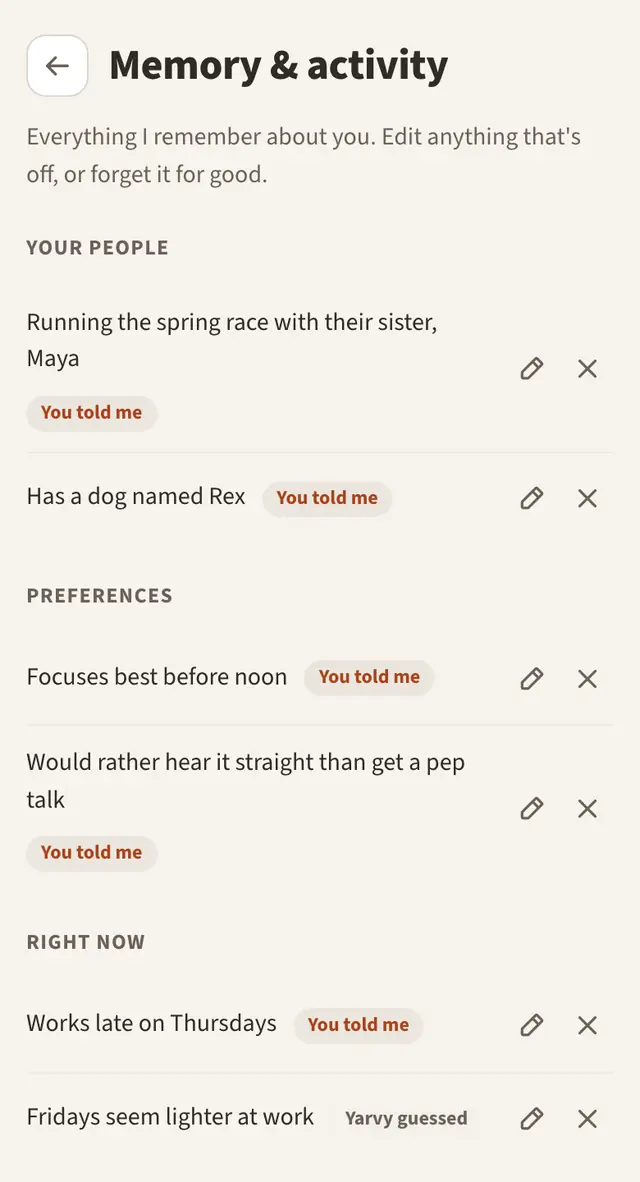
Mention that Thursdays are your late night, that you're training with your sister, or that you'd rather hear it straight. Yarvy keeps the lasting stuff and uses it when it plans with you, so you never explain your week twice.
Memory you can't see is creepy, so you can see all of it. Every fact is marked "you told me" or "Yarvy guessed," and you can fix or delete any line.
It keeps the real record
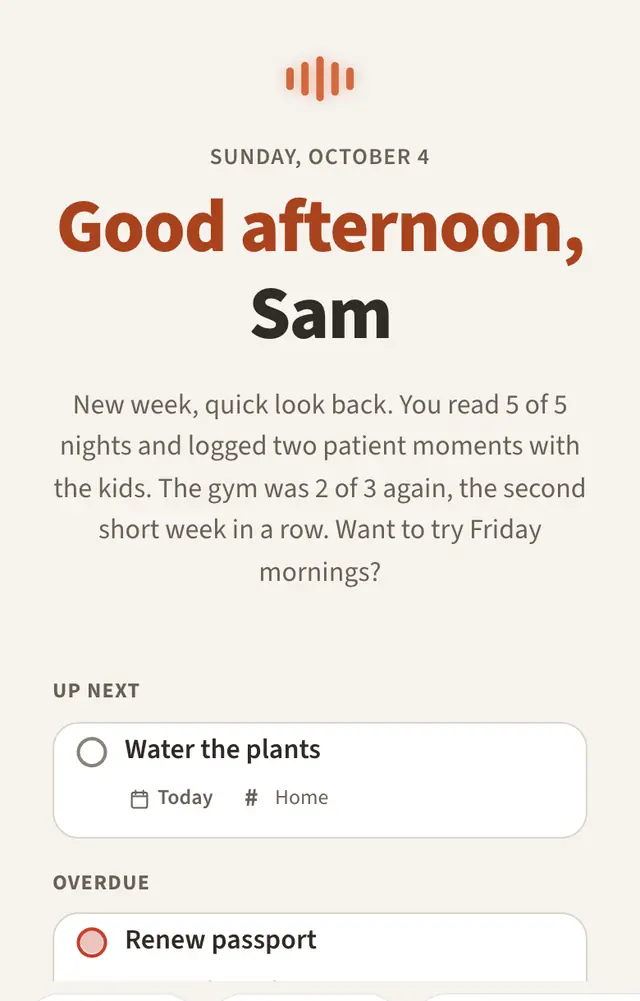
Your goals and your list live in Yarvy, so a check-in is about what actually happened, not your memory of it. The first time you open it each week, you get a short look back across your goals: what went well, what slipped, and one thing that might help.
Day to day, it connects the dots for you. Behind on the gym in a week with a late Thursday? It'll point to Friday instead.
Honest, not harsh
Good accountability tells you the truth and then helps. Yarvy is built to do both.
- No flattery. If a goal is behind, it says so plainly, worked out from what you actually did.
- No guilt. Gone for a week? It welcomes you back and picks up where you are, without a lecture.
- No nagging. One suggestion at a time, and if you say no, it drops it.
- A way forward. Behind on a goal? Move the date, shrink the target, change this week, or pause it. More on goals.